
Lektionen (7 von 16)
Deciding What to Self-Perform vs Subcontract
Every bid you build depends on a decision you make before you write a single line item: what does your crew do, and what do you hand off to a sub? Get this wrong and you either bleed money on work you're not fast at, or you take on liability you're not licensed to carry.
The Three Filters: Licensing, Skill, and Schedule
Run every task on the hall bathroom job through three filters before deciding who performs it. First, licensing. In most states, plumbing rough-in and electrical work require a licensed tradesperson to pull the permit and perform the work, and doing it without one can void inspections, void insurance coverage, and expose you to fines. This varies significantly by state and sometimes by municipality, so you check your local licensing board before you assume anything, not after. Second, crew skill. Even if a task doesn't legally require a license, like demo, tile setting, or flooring, ask honestly whether your crew can do it at a quality and speed that makes it profitable. A crew that takes three days to tile a shower that a specialist does in one day isn't saving you money by self-performing, it's costing you two days of overhead and a slower project timeline. Third, schedule. Subcontractors have their own calendars. If your plumber is booked out three weeks, that gap might force you to resequence the whole job, and that risk has to be priced in somewhere, usually as contingency or as a coordination markup. On a typical hall bathroom remodel, demo, tile, and flooring are commonly self-performed by a general remodeling crew, while plumbing rough-in, electrical, and sometimes HVAC or structural work go to licensed subs. Fixture-setting (toilet, vanity faucet) sometimes falls to the GC crew if local code allows it and the sub's rough-in already passed inspection.
Pricing Self-Performed Work
Self-performed work gets priced from your own labor and material takeoff, the same method covered earlier in this course. You estimate hours per task using your crew's actual production rates, not a generic industry average, multiply by your fully burdened labor rate, and add material costs with your standard markup. For example, if your crew demos a hall bathroom (removing tile, vanity, toilet, and tub surround) in 1.5 days at two workers, and your burdened labor rate is $45/hour per worker, that's 24 hours at $45, or $1,080 in labor, plus disposal fees. You know this number is defensible because it's built from real line items you can show a client: hours, rate, and material cost, each one documented.
Pricing Subcontracted Work
Subcontracted work is priced differently. You're not building a labor and material takeoff for the plumber's rough-in work, you're getting a quoted lump sum from the sub and adding your own markup on top. That markup, commonly in the 10% to 20% range depending on the trade and your market, compensates you for three things: scheduling and coordinating the sub around your other trades, taking on the risk that the sub's work fails inspection or needs rework on your dime, and the administrative time of managing the relationship. If your plumber quotes $2,400 for the rough-in and relocation of the drain line, and your standard sub markup is 15%, you present that line item to the client at $2,760. You don't itemize the plumber's labor and material breakdown on your bid, you present it as a single subcontracted scope with your markup baked in.
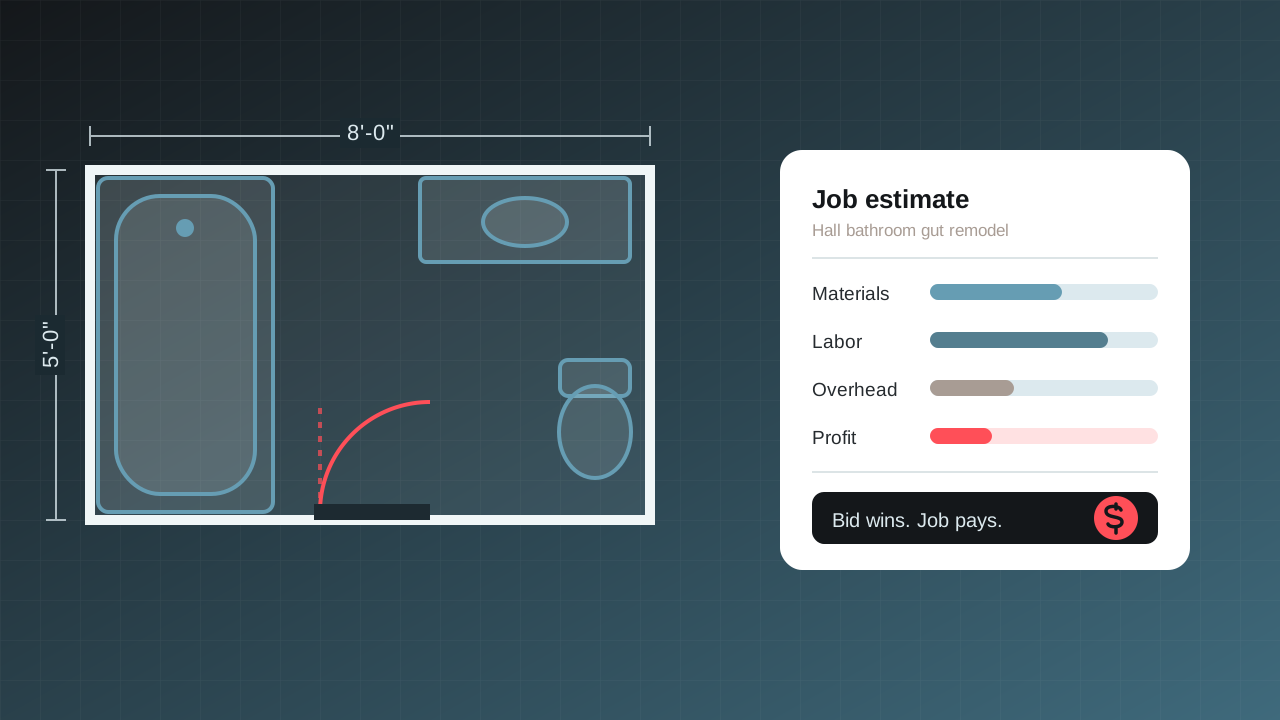
Szenario: A hall bathroom remodel: client wants to move the toilet 18 inches to accommodate a larger vanity, which requires moving a drain line, plus full re-wiring of a vanity light and new GFCI outlet, plus demo, tile, and vinyl plank flooring.
Step 1: Flag licensing triggers. Moving a drain line is plumbing rough-in work, and in most states that requires a licensed plumber. Re-wiring a light circuit and adding a GFCI outlet is electrical work, and in most states that requires a licensed electrician. Check your local requirements, since some states allow licensed GCs to perform limited electrical or plumbing work themselves, but many do not. Step 2: Decide self-performed scope. Demo, tile setting, and vinyl plank flooring don't require a specialty license, and your crew has done this work reliably on past jobs, so you self-perform these. Step 3: Price self-performed work from takeoff. Demo: 24 hours at $45/hour burdened rate = $1,080, plus disposal $150. Tile: 120 square feet of wall and floor tile at an estimated 0.375 hours per square foot for your crew (including prep and grout) = 45 hours at $45/hour = $2,025, plus material at $4.50/sq ft = $540. Flooring: 40 square feet of vinyl plank at 0.4 hours per square foot = 16 hours at $45/hour = $720, plus material at $3/sq ft = $120. Step 4: Get sub quotes. Plumber quotes $1,800 for the drain line move and fixture rough-in. Electrician quotes $950 for the re-wire and GFCI addition. Step 5: Apply sub markup. At a 15% coordination markup: plumber line becomes $2,070, electrician line becomes $1,092.50. Step 6: Assemble the bid. Each self-performed task appears as its own line item with labor and material broken out. Each subcontracted task appears as a single line item at the marked-up lump sum, with no internal breakdown shown to the client. Total subtotal before your overall project markup: $1,080 + $150 + $2,025 + $540 + $720 + $120 + $2,070 + $1,092.50 = $7,797.50.
Wichtigste Erkenntnisse
- •Check licensing requirements locally before assuming plumbing or electrical work can be self-performed, since rules vary significantly by state and sometimes by city.
- •Self-performed work is priced from your own labor and material takeoff using your crew's actual production rates and your fully burdened labor rate.
- •Subcontracted work is priced as the sub's quoted lump sum plus a coordination and risk markup, commonly in the 10% to 20% range, not itemized line by line.
- •Crew skill matters even when licensing isn't required: a task your crew is slow at can cost more to self-perform than to sub out, even before accounting for overhead.
- •Subcontractor availability affects your schedule and therefore your risk, so factor sub lead times into your sequencing and pricing decisions.