
Lessons (8 of 16)
Adding a Material Waste Factor and Using Supplier Quotes
Ordering the exact square footage from your takeoff is a rookie mistake that guarantees a mid-job material run. This lesson covers how to pad quantities with a waste factor and how to handle supplier quotes so a price increase doesn't quietly eat your profit.
Why Raw Takeoff Numbers Are Never the Order Quantity
Your takeoff tells you how much surface area needs to be covered, not how much material to buy. Every tile job loses material to cuts at edges, corners, outlets, and fixtures, plus breakage in handling and the occasional box with a cracked piece or dye-lot mismatch you have to set aside. If you order to the exact square footage and anything goes wrong, you're stopping mid-install to source more material, and there's no guarantee the new box matches the dye lot of what's already on the wall. For standard layouts (tile set square to the walls, average-size format like 4x16 or 12x12), a waste factor of commonly 10 to 15 percent is typical. This covers normal cutting loss around a tub, niche, or doorway. That factor goes up when the layout gets harder to execute efficiently. Diagonal (herringbone or 45-degree) layouts commonly push waste to 15 to 20 percent because nearly every row ends in an angled cut, and those offcuts usually can't be reused elsewhere. Large-format tile (think 12x24 or bigger) also commonly runs higher, often 15 to 20 percent, because a single miscut wastes a much bigger and more expensive piece, and large tile is more prone to cracking in transport and handling. The waste factor isn't padding your profit margin. It's a material planning number that belongs in the estimate as its own visible line so the client understands why you're buying more tile than the room technically needs. Skipping this step is one of the most common reasons contractors eat a second delivery charge and a schedule delay out of their own pocket.
Applying the Waste Factor to the Hall Bathroom
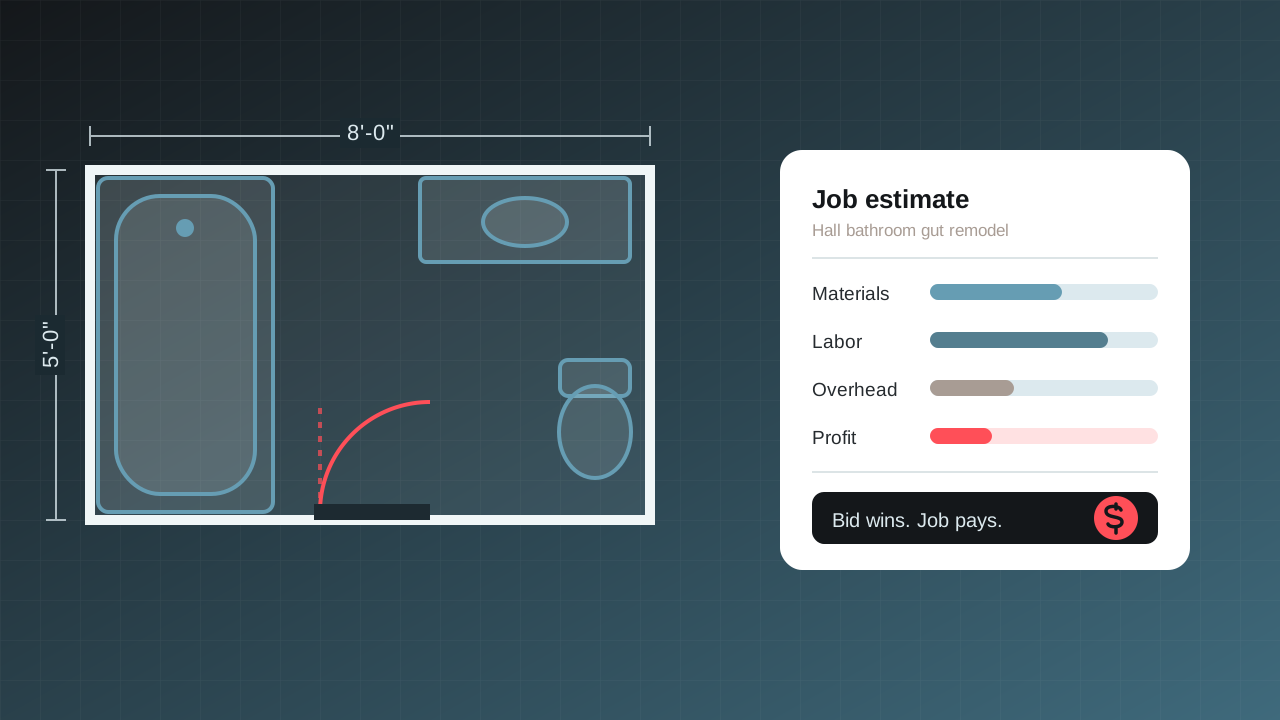
Take the hall bathroom's wall tile takeoff of 80 square feet. If this is a standard layout (tile set straight, average format, modest cutting around the tub and one niche), apply a 10 percent waste factor as a baseline: 80 sq ft x 1.10 = 88 sq ft to order If the client has chosen a large-format tile (say 12x24 subway-style stacked vertically) or a diagonal accent pattern on a feature wall, move the factor up to 15 percent: 80 sq ft x 1.15 = 92 sq ft to order That 4 to 12 square foot swing matters because tile is typically sold by the box, and boxes cover a fixed square footage, commonly in the range of 8 to 15 square feet per box depending on size and manufacturer. You round up to the nearest full box every time, since suppliers generally don't sell partial boxes. If a box covers 10.8 square feet, 88 square feet needs 9 boxes (97.2 sq ft), and 92 square feet still needs 9 boxes. Always do this rounding on the actual box coverage from the supplier spec sheet, not a guess, since it directly changes your material cost line and the number you hand to the supplier for a quote.
Why Supplier Quotes Belong in the Estimate, and Why They Expire
Once you know the adjusted order quantity, get a written quote from your supplier for that exact quantity and attach it to the estimate you give the client. This does two things. First, it shows the client your material pricing is real, not a guess, which builds credibility and makes the bid harder to challenge. Second, it protects you: if the client questions a cost later, you can point to a dated, itemized document instead of defending a number from memory. Supplier quotes typically carry an expiration window, commonly 15 to 30 days, because material costs (especially tile, stone, and anything imported) can shift with supplier inventory, manufacturer price changes, or seasonal demand. A quote that was accurate when you built the estimate can be stale by the time the client signs. This creates a real exposure: if your proposal doesn't have its own validity period, you can end up contractually bound to a price based on a supplier quote that expired weeks earlier. If material cost jumps 8 percent between bid and signing, that jump comes straight out of your margin unless the estimate explicitly protects against it. The fix is simple and should be standard on every proposal: state a validity period on the estimate itself, commonly 30 days, matched to or shorter than your supplier quote's expiration. Include a line noting that pricing is based on the attached supplier quote and is subject to revision if material costs change after the stated validity period. This isn't adversarial, it's standard practice, and it keeps a market price swing from becoming your problem instead of a shared one.
Scenario: The hall bathroom remodel calls for 80 square feet of wall tile. The client has selected a 12x24 large-format porcelain tile set in a straight stack pattern (not diagonal, but still large-format). The supplier sells this tile in boxes covering 11.2 square feet each, and the per-box price is $64.
Step 1: Identify the waste factor. Because this is large-format tile, apply 15 percent rather than the standard 10 percent, even though the layout itself is straight-set (the format alone drives the higher cutting and breakage risk). Step 2: Calculate adjusted quantity. 80 sq ft x 1.15 = 92 sq ft needed. Step 3: Convert to boxes. 92 sq ft / 11.2 sq ft per box = 8.21 boxes. Round up to 9 boxes, since the supplier doesn't sell partial boxes. 9 boxes covers 100.8 square feet, meaning the final order is actually 26 percent above the raw takeoff, not 15 percent, purely because of box rounding. That's normal and should be expected, not treated as an error. Step 4: Get the supplier quote. 9 boxes x $64 = $576 for tile. Request this in writing from the supplier, with the quote showing the SKU, quantity, unit price, and an expiration date (for example, valid for 20 days from issue). Step 5: Attach and date the estimate. Attach the $576 supplier quote to the client proposal as backup for the tile line item. On the proposal itself, add a validity statement: 'This estimate is valid for 15 days from the date below. Material pricing is based on the attached supplier quote and may be revised if that quote expires or pricing changes prior to signed acceptance.' Setting the estimate's validity period (15 days) shorter than the supplier quote's expiration (20 days) builds in a buffer so you're never caught holding a price the supplier has already moved on.
Key takeaways
- •Apply a waste factor before ordering material: commonly 10 to 15 percent for standard layouts, rising to 15 to 20 percent for diagonal patterns or large-format tile due to more cuts and higher breakage risk.
- •Always round the final order up to full boxes based on actual supplier coverage per box, since this rounding can push your real order well above the waste-adjusted number.
- •Attach the actual written supplier quote to your client estimate so material costs are documented and defensible, not based on memory or a verbal price.
- •Supplier quotes expire, commonly within 15 to 30 days, so your own proposal needs a stated validity period, ideally shorter than the supplier's expiration, or you risk absorbing a material price increase yourself.
- •The waste factor is a material planning line, not a profit padding tool. It should be itemized and explained, not buried silently in the total.