
Leçons (9 sur 16)
Separating Direct Costs, Overhead, and Profit
Most contractors can tell you what a job costs in labor and material. Far fewer can tell you what it costs just to keep the lights on, and that gap is where profit quietly disappears.
What Counts as a Direct Job Cost
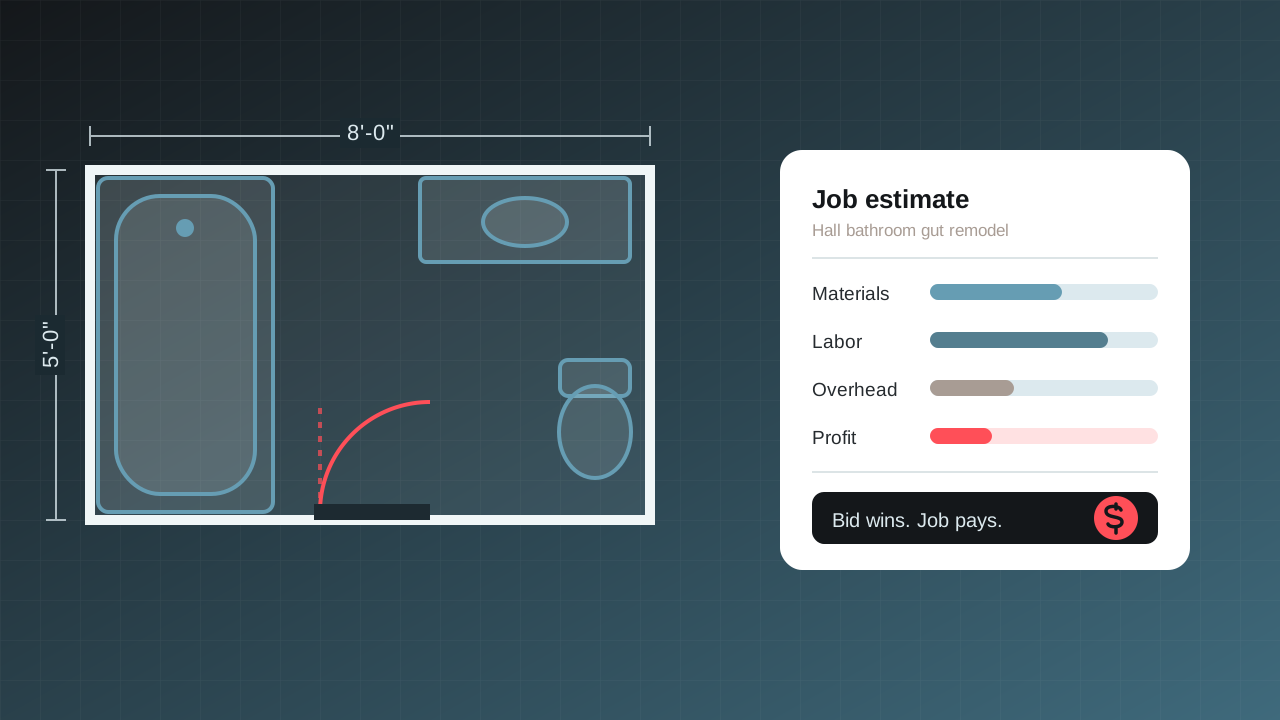
A direct cost is anything that exists only because this specific job exists. If you cancelled the hall bathroom remodel tomorrow, these costs would disappear with it. For that job, direct costs typically include: the plumber's and tile setter's labor hours, the vanity, tub surround, tile, grout, and fixtures, subcontractor invoices for electrical or plumbing work you don't self-perform, the dumpster rental for demo debris, and permit fees tied to that address. Each of these has a dollar amount you can trace straight back to this one job on this one street. If you wrote this job's name on an envelope and stuffed every receipt connected to it inside, everything in that envelope is a direct cost. This is the easy part of estimating, and most contractors already do it reasonably well, because the numbers show up on supplier receipts and sub invoices. The mistake happens one layer up, when contractors assume that once direct costs are covered, whatever's left over is pure profit. It isn't. There's a whole category of real, recurring costs that never show up in that envelope because they don't belong to any single job. That's overhead, and it has to be paid for too, out of every job you run, including this one.
What Counts as Overhead
Overhead is every cost that keeps your business able to operate, whether or not the hall bathroom job ever happened. Commonly this includes general liability and workers' comp insurance premiums, your truck payment, fuel, and maintenance, tools and equipment that aren't consumed by one job, estimating or invoicing software subscriptions, a phone and office line, marketing and website costs, and your own admin time spent quoting jobs that don't convert. None of these shrink to zero if this particular bathroom job disappears. Your insurance premium is due in January whether you remodeled one bathroom or ten. A typical small remodeling contractor might find overhead running somewhere in the range of 15 to 30 percent of total revenue, though this varies widely by business size, vehicle fleet, and how much they've invested in marketing. The important shift here is mental: overhead isn't a side expense you pay from profit. It's a cost of doing business that has to be baked into every single price you quote, spread across all your jobs for the year, or you'll eventually run out of cash even while every individual job looks profitable on paper.
Why Lumping Overhead Into Profit Underprices Every Job
Here's the trap: a contractor estimates the hall bathroom job, totals up labor and material at $9,000, adds what feels like a healthy $1,500 'profit' on top, and quotes $10,500. It feels like a 14 percent profit margin. But that $1,500 was never profit, it was overhead money wearing a profit costume. If this contractor's actual overhead runs $1,200 on a job this size, true profit is only $300, about 3 percent, not 14. Multiply that mistake across 20 jobs a year and the business is quietly bleeding even though every invoice looked fine. This is the single most common reason remodelers stay busy year-round and still can't explain where the money went. Overhead and profit are two different line items with two different jobs: overhead keeps the business alive, profit is what makes running the business worth the risk. When they're merged into one fuzzy number, you can't price confidently, you can't tell a client why your bid is what it is, and you can't defend your number when someone asks you to 'just knock off a little.' Separating them is what makes the next step, markup and margin math, actually work.
Scénario : A contractor is pricing the hall bathroom remodel: demo, new tub surround, tile floor, vanity, and fixture swap. Direct costs are tallied from supplier quotes and sub bids.
Step 1: List direct costs only. Labor (your crew's hours at their loaded hourly rate): $3,800. Materials (tile, vanity, tub surround, fixtures, grout, adhesive): $3,100. Subcontractor (licensed electrician for the vanity light and fan): $650. Dumpster rental for demo debris: $450. Permit fee: $150. Total direct cost: $8,150. Step 2: Set this number aside as the job's true direct cost, the number that disappears if the job doesn't happen. Step 3: Separately, calculate what overhead this job needs to carry. Say this contractor's annual overhead (insurance, truck, tools, software, phone, marketing) totals $54,000, and they run about 36 similar-sized jobs a year. That's $1,500 of overhead that needs to be recovered per job on average. Step 4: Add these as distinct lines rather than blending them: $8,150 direct cost plus $1,500 overhead recovery equals $9,650 as the true 'break-even' price, the number where the business neither gains nor loses. Step 5: Profit is only what's added on top of that $9,650, not on top of the original $8,150. If the contractor wants a 15 percent profit margin on this job, profit needs to be calculated against the full cost basis, not just direct costs, which the next lesson will walk through with the actual markup formula.
Points clés
- •Direct costs are traceable to one specific job (labor, material, subs, dumpster, permits); overhead exists regardless of whether this job happens (insurance, vehicle, tools, software, marketing).
- •Treating leftover money after direct costs as pure profit is a common and costly mistake, because it's usually covering unaccounted-for overhead instead.
- •Overhead typically runs somewhere in the 15 to 30 percent of revenue range for small remodeling contractors, though this varies by business, and it must be recovered across every job, not absorbed into 'profit.'
- •A job can look profitable on an invoice and still be bleeding the business dry if overhead was never separated out and priced in.
- •Keeping direct cost, overhead, and profit as three distinct numbers is what makes markup and margin calculations (covered next) accurate instead of guesswork.