
Lekcje (10 z 16)
Markup vs Margin: the Math and the Difference
Markup and margin are both expressed as percentages, both involve cost and profit, and both get confused constantly, usually right before a contractor realizes their 'healthy' 25 percent markup actually left them with a much thinner margin than they thought. This lesson separates the two for good, with the formula and the dollar figures to prove it.
Two Different Questions
Markup answers: how much am I adding on top of my cost? Margin answers: of the final price the customer pays, what share is actually profit? They use the same two numbers (cost and profit) but divide them differently, and that difference matters when you're pricing jobs. Markup formula: Markup % = Profit / Cost. If your direct cost is $9,000 and you add $2,250 in profit, that's a 25 percent markup ($2,250 / $9,000 = 0.25). Margin formula: Margin % = Profit / Selling Price. Using the same job, your selling price is $9,000 + $2,250 = $11,250. Margin = $2,250 / $11,250 = 0.20, or 20 percent. Same job, same dollars of profit, two different percentages depending on which number you divide by. That gap isn't a rounding error. It widens as the percentage grows, and it's the single most common reason contractors underprice their work: they hear '20 percent' in their head, assume it means margin, price using markup instead, and quietly give away profit without realizing it. In this trade, when someone says 'I markup 20 percent,' they typically mean they add 20 percent to cost, not that 20 percent of the final price is profit. If you're used to thinking in margin (common in retail and some business contexts) and you apply that mental model to a markup number, you will consistently underbid. Knowing which one you're using, and which one you're quoting to a client or partner, is a baseline professional skill, not a nuance.
The Conversion Formula
You don't need to guess at the relationship between markup and margin. There's a direct formula: Margin = Markup / (1 + Markup) Run it with a 25 percent markup: 0.25 / (1 + 0.25) = 0.25 / 1.25 = 0.20. A 25 percent markup produces a 20 percent gross margin. That's a fixed mathematical relationship, not an approximation. Now run it with a 20 percent markup: 0.20 / (1 + 0.20) = 0.20 / 1.20 = 0.1667, or roughly 16.7 percent margin. Notice the pattern: margin is always lower than markup, for any markup above zero. The gap grows as the percentage increases. A 50 percent markup, for instance, converts to a 33.3 percent margin, not 50 percent. People who assume the two numbers are interchangeable, or close enough, are consistently overestimating how much profit they're actually keeping. The reverse formula is just as useful when you're working backward from a target margin: Markup = Margin / (1 - Margin). If you need a 20 percent margin to hit your business goals, the markup required is 0.20 / (1 - 0.20) = 0.20 / 0.80 = 0.25, or 25 percent markup. This is typically how experienced estimators actually work: they start with the margin they need to stay profitable, then convert it to the markup percentage they apply to cost on the estimate.
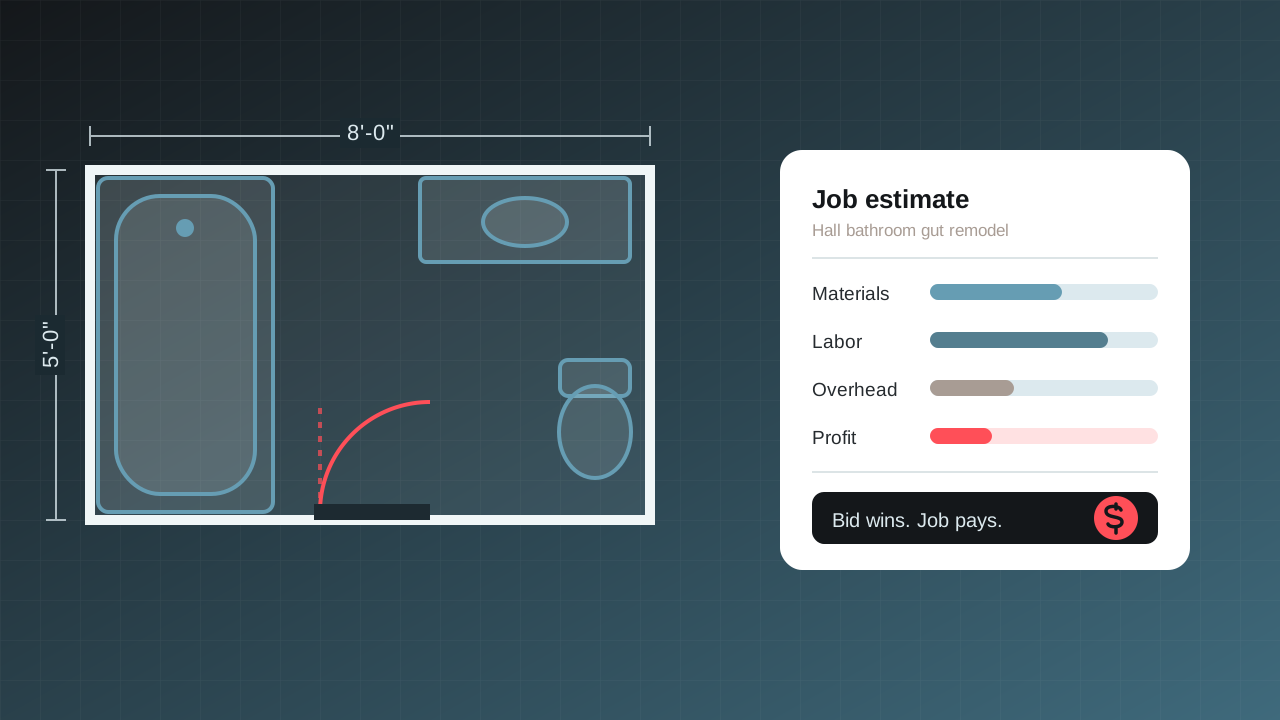
Scenariusz: A hall bathroom remodel has a direct cost of $9,000 (materials, labor, subcontractors, permits, all in). You're deciding whether to price the job using a 25 percent markup or a 20 percent markup, and you want to see the actual dollar difference before you send the bid.
Step 1: Apply a 25 percent markup. Profit = $9,000 x 0.25 = $2,250. Selling price = $9,000 + $2,250 = $11,250. Check the margin on this price: $2,250 / $11,250 = 20 percent margin. Step 2: Apply a 20 percent markup instead. Profit = $9,000 x 0.20 = $1,800. Selling price = $9,000 + $1,800 = $10,800. Check the margin: $1,800 / $10,800 = 0.1667, or 16.7 percent margin. Step 3: Compare the outcomes. The 25 percent markup bid is $11,250. The 20 percent markup bid is $10,800. That's a $450 difference in your pocket on a single hall bathroom, just from choosing 25 percent over 20 percent markup on the estimate. Step 4: Now suppose you need your business to run on a 20 percent margin, not a 20 percent markup, to cover overhead and stay healthy. Using the conversion formula, Markup = 0.20 / (1 - 0.20) = 0.25. You'd need to apply a 25 percent markup, not 20 percent, to actually hit a 20 percent margin. If you'd mistakenly used a 20 percent markup thinking it gave you a 20 percent margin, you'd have under-priced this job by $450 and only realized a 16.7 percent margin, likely without ever noticing the shortfall until your books told you at year end.
Najważniejsze wnioski
- •Markup is profit divided by cost; margin is profit divided by selling price. Same profit dollars, different denominators, different percentages.
- •Convert markup to margin with Margin = Markup / (1 + Markup); convert margin to markup with Markup = Margin / (1 - Margin).
- •Margin is always lower than markup for any positive percentage, and the gap widens as the percentage grows, so a 25 percent markup is only a 20 percent margin, not a matching number.
- •On a $9,000 hall bathroom, a 25 percent markup prices the job at $11,250 while a 20 percent markup prices it at $10,800, a $450 swing from one percentage point choice.
- •Decide your target margin first based on what your business actually needs to stay profitable, then convert that to the markup percentage you apply on the estimate, rather than picking a markup number out of habit.