
Lekcje (6 z 16)
Pricing Labor with a Burdened Hourly Rate
If you price labor using the wage you pay your employee, you are quietly giving away profit on every job. This lesson shows you how to calculate the true burdened hourly cost of labor and why that number, not the wage, belongs in your estimate.
Wage vs. Burdened Rate: What's the Difference
The wage is what shows up on your employee's paycheck, say $25 per hour. The burdened rate is what that hour actually costs your business once you stack on everything else you're legally and practically required to pay because that person is on the clock. That typically includes employer payroll taxes (Social Security, Medicare, federal and state unemployment), workers' compensation insurance, and often a share of general liability insurance, plus benefits if you offer them like health insurance or paid time off. None of that shows up on the employee's pay stub, but all of it comes out of your pocket. Many beginners estimate a tile setting job by multiplying hours by the $25 wage, hand that number to the customer, and feel good about it. The problem is the job actually costs you $34 to $38 an hour to staff once burden is included. That gap, multiplied across every hour of every job, is often the exact size of a contractor's 'missing' profit at the end of the year. Burden rates vary by state, by trade classification, and by your specific insurance experience modifier, so treat any single percentage as a planning estimate, not a fixed law. A common rough range for small residential contractors is 35 to 55 percent added on top of wage, though workers' comp alone for roofing or heavy demo can push this higher than for lighter finish work like tile or trim. The only way to know your real number is to calculate it from your actual payroll tax rates, your actual workers' comp premium for that labor classification, and your actual insurance costs, then divide by actual hours worked in a year.
Building Your Burdened Rate
Start with the wage, then add each cost as a percentage of that wage. A typical breakdown might look like this: employer payroll taxes around 7.65 percent for FICA, plus unemployment insurance (commonly 1 to 3 percent depending on state and claims history), plus workers' compensation (commonly 5 to 25 percent of wages depending on trade risk and your state's rates, tile and finish work usually sits lower, demo and framing usually sits higher), plus a general liability allocation (often 2 to 5 percent), plus paid time off and any benefits you offer (commonly 5 to 15 percent). Add those together and you commonly land in the 35 to 55 percent range over wage. For a $25 per hour wage, a 40 percent burden adds $10, landing you at $35 per hour burdened. A 50 percent burden adds $12.50, landing at $37.50. That's where the commonly cited '$34 to $38 burdened' range for a $25 wage comes from. This is before you add your overhead and profit markup, which is a separate layer applied on top of burdened labor cost, not a replacement for it. The practical move: calculate this once per employee or per labor classification, keep it on a reference sheet, and use that number every time you build an estimate. Update it at least annually, since insurance premiums and tax rates shift.
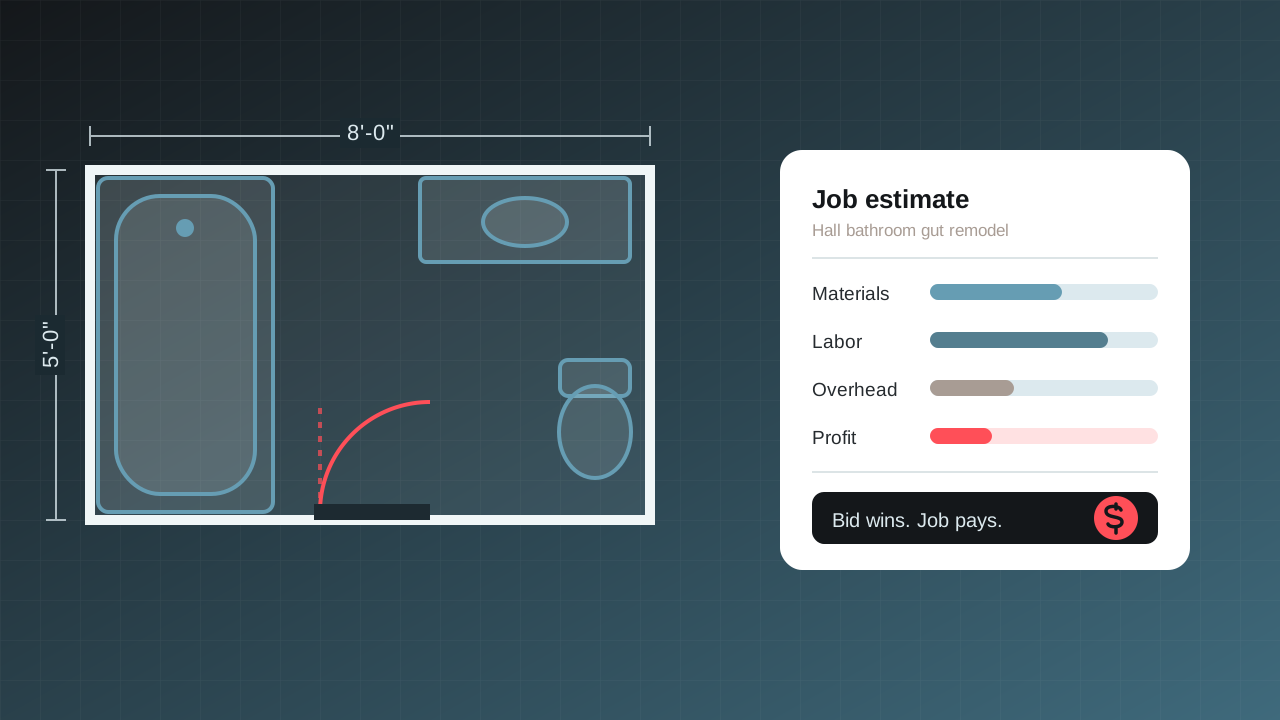
Scenariusz: You're estimating labor for the hall bathroom remodel. The job needs 6 hours of demo and 14 hours of tile setting. Your demo laborer earns $22 per hour wage, and your tile setter earns $28 per hour wage. You've calculated your burden rates at 45 percent for demo labor (higher workers' comp classification) and 35 percent for tile setting (lower risk classification).
Step 1: Calculate the demo burdened rate. $22 wage times 1.45 (45 percent burden) equals $31.90 per hour burdened, round to $32. Step 2: Calculate the tile burdened rate. $28 wage times 1.35 (35 percent burden) equals $37.80 per hour burdened, round to $38. Step 3: Multiply burdened rate by estimated hours for each task. Demo: $32 times 6 hours equals $192. Tile setting: $38 times 14 hours equals $532. Step 4: Total burdened labor cost for the job equals $192 plus $532, which is $724. Step 5: Compare to the wage-only mistake. If you'd priced this using raw wages instead, demo would be $22 times 6 equals $132, and tile would be $28 times 14 equals $392, for a total of $524. That's $200 less than your true labor cost, meaning every dollar of that $200 gap comes straight out of your profit margin before you've even added overhead and markup. Step 6: This $724 burdened labor figure is now your real cost basis. Overhead and profit markup get applied on top of this number in a later step, not folded into it.
Najważniejsze wnioski
- •The burdened rate includes payroll taxes, workers' compensation, and insurance costs on top of wage, and it's typically 35 to 55 percent higher than the wage itself, though this varies by trade and location.
- •Burden rates differ by task risk level, demo and heavy labor commonly carry higher workers' comp rates than finish work like tile setting, so calculate burden per labor classification rather than using one flat number for every task.
- •Always multiply burdened rate, not wage, by estimated hours when building a line-item estimate, since using wage alone understates true labor cost on every single job.
- •Burdened labor cost is a separate step from overhead and profit markup, burden gets you to your true cost, markup gets you to your price.
- •Calculate your actual burden percentage from your real payroll tax rates, workers' comp premiums, and insurance costs at least once a year, since these figures shift and a stale number will quietly misprice every bid you write.